News and Enhancements of rpact, an R Package for Adaptive Confirmatory Designs
Kolloquium Statistische Methoden in der empirischen Forschung
RPACT GmbH
January 13, 2026
This presentation is accessible at smidef.presentation.2026.rpact.com.
Seven Years Ago

The rpact Package 📦
- Comprehensive validated R package implementing methodology described in Wassmer and Brannath (2016)
- Enables the design of traditional and confirmatory adaptive group sequential designs
- Provides interim data analysis and simulation including early efficacy stopping and futility analyses
- Enables sample-size reassessment with different strategies
- Enables treatment arm selection in multi-stage multi-arm (MAMS) designs
- Enables subset selection in population enrichment designs
- Provides a comprehensive and reliable sample size calculator

Developed by RPACT 🏢
- RPACT GbR company founded in 2017 by Gernot Wassmer and Friedrich Pahlke
- Idea: open source development with help of “crowd funding”
- Currently supported by 21 companies
- \(>\) 80 presentations and training courses since 2018, e.g., FDA in March 2022
- 30 vignettes based on Quarto and published on rpact.org/vignettes
- 28 releases on CRAN since 2018
- New partner Daniel Sabanés Bové joined formally in October 2025




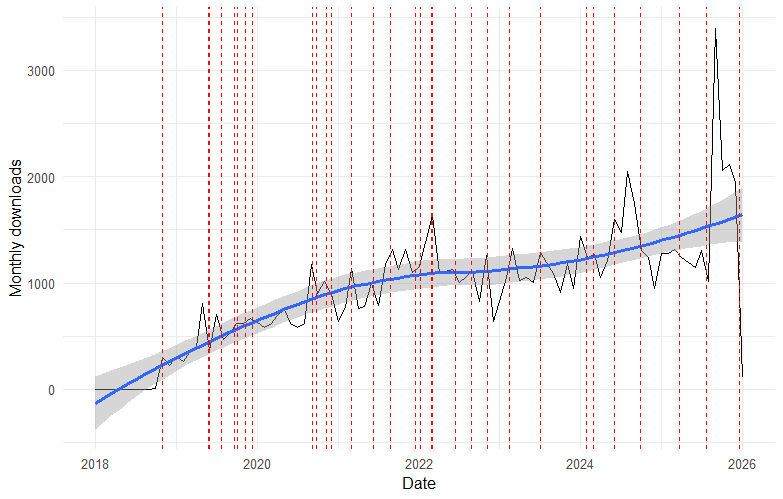
CRAN Downloads ✌️
RCONIS 🚀
- Grow RPACT company to offer a wider range of services
- Statistical consulting and engineering services: Research Consulting and Innovative Solutions
- Joint venture between RPACT GmbH (rpact.com) and inferential.biostatistics GmbH (inferential.bio) founded by Daniel Sabanés Bové and Carrie Li
- Website: rconis.com

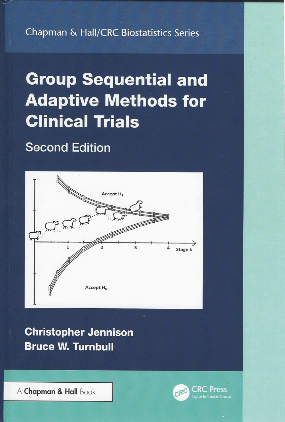
Second Edition of the Wassmer and Brannath Book

- Provides up-to-date overview of group sequential and confirmatory adaptive designs in clinical trials
- Describes available software including R packages and has
rpactcode examples - Supplemented with a discussion of practical applications
- Published Oct 2025
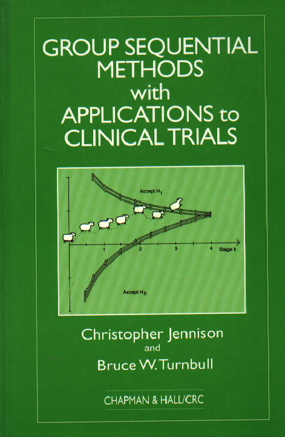
Second Edition of Jennison and Turnbull
The R Package rpact – Functional Range

Trial Designs 🔬
- Fixed sample designs:
- continuous, binary, count, survival outcomes
- Group sequential designs:
- efficacy interim analyses, futility stopping, alpha-spending functions
- Adaptive designs:
- Inverse normal and Fisher’s combination test, conditional error rate principle
- Provides adjusted confidence intervals and bias corrected estimates
- Multi-arm multi-stage (MAMS) and enrichment designs, sample size reassessment
Sample Size and Power Calculation 💻
Sample size and power can be calulcated for testing:
- means (continuous endpoint)
- proportions (binary endpoint)
- hazards (survival endpoint)
- Note: flexible recruitment and survival time options
- rates (count endpoint)
Example: Sample Size Calculation 🧮
Sample size calculation for a continuous endpoint
Sequential analysis with a maximum of 3 looks (group sequential design), one-sided overall significance level 2.5%, power 80%. The results were calculated for a two-sample t-test, H0: mu(1) - mu(2) = 0, H1: effect = 2, standard deviation = 5.
| Stage | 1 | 2 | 3 |
|---|---|---|---|
| Planned information rate | 33.3% | 66.7% | 100% |
| Cumulative alpha spent | 0.0001 | 0.0060 | 0.0250 |
| Stage levels (one-sided) | 0.0001 | 0.0060 | 0.0231 |
| Efficacy boundary (z-value scale) | 3.710 | 2.511 | 1.993 |
| Futility boundary (z-value scale) | 0 | 0 | |
| Efficacy boundary (t) | 4.690 | 2.152 | 1.384 |
| Futility boundary (t) | 0 | 0 | |
| Cumulative power | 0.0204 | 0.4371 | 0.8000 |
| Number of subjects | 69.9 | 139.9 | 209.8 |
| Expected number of subjects under H1 | 170.9 | ||
| Overall exit probability (under H0) | 0.5001 | 0.1309 | |
| Overall exit probability (under H1) | 0.0684 | 0.4202 | |
| Exit probability for efficacy (under H0) | 0.0001 | 0.0059 | |
| Exit probability for efficacy (under H1) | 0.0204 | 0.4167 | |
| Exit probability for futility (under H0) | 0.5000 | 0.1250 | |
| Exit probability for futility (under H1) | 0.0480 | 0.0035 |
Legend:
- (t): treatment effect scale
Adaptive Analysis 📈
Perform interim and final analyses during the trial using group sequential method or p-value combination test (inverse normal or Fisher)
Calculate adjusted point estimates and confidence intervals (cf., Robertson et al. (2023), Robertson et al. (2025))
Perform sample size reassessment using the observed data, e.g., based on calculation of conditional power
Easy to understand R commands:
Some highlights:
- Automatic boundary recalculations during the trial for analysis with alpha spending approach, including under- and over-running
- Adaptive analysis tools for multi-arm trials and enrichment designs
Simulation Tool 🧪
Obtain operating characteristics of different designs:
- Assessment of adaptive sample size recalculation strategies
- Assessment of treatment selection strategies in multi-arm trials
- Assessment of population selection strategies in enrichment designs
Recent Updates

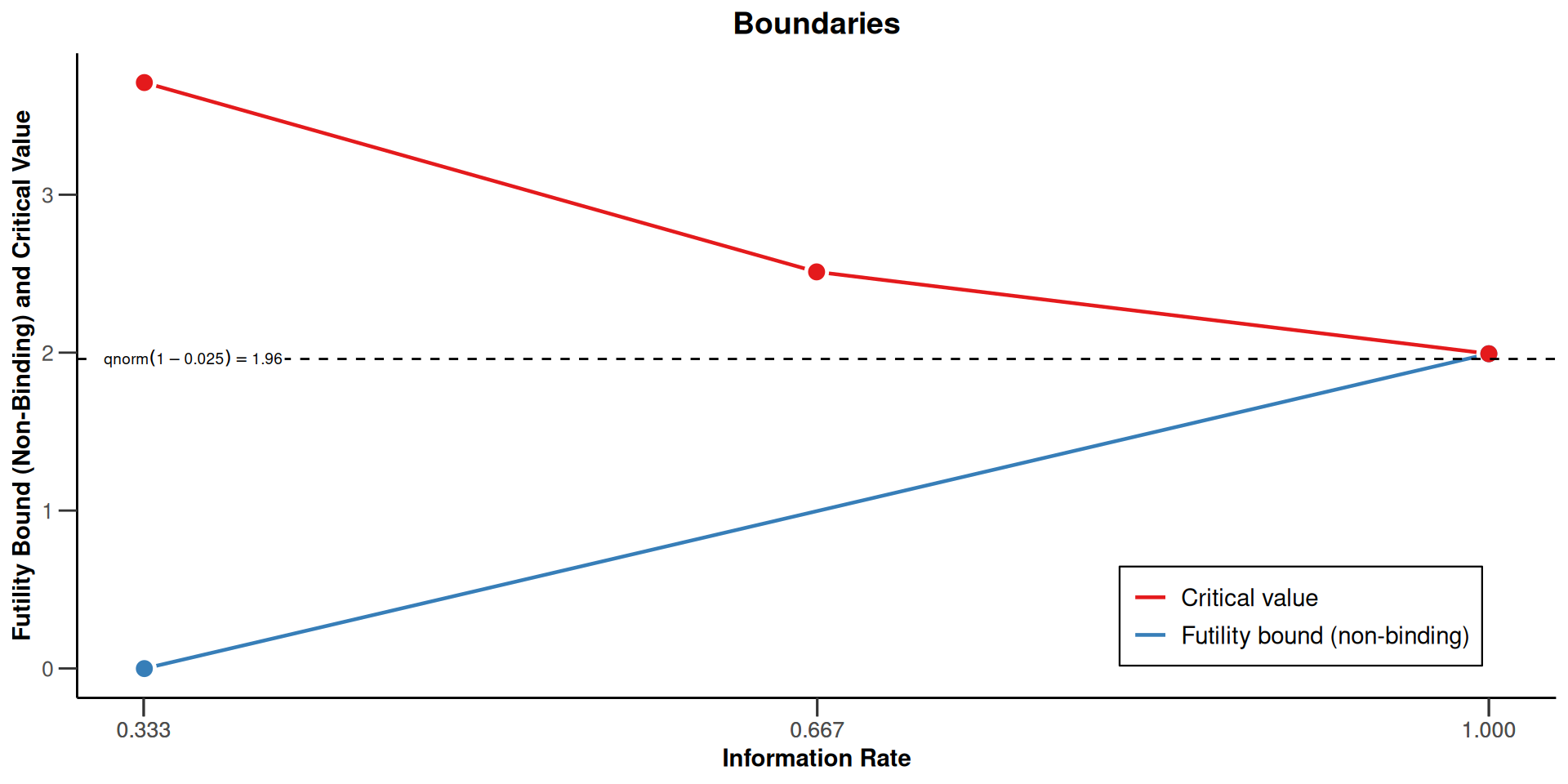
1. Specification of Futility Bounds
Current situation:
Sequential analysis with a maximum of 3 looks (group sequential design)
O’Brien & Fleming design, non-binding futility, one-sided overall significance level 2.5%, power 80%, undefined endpoint, inflation factor 1.0628, ASN H1 0.8528, ASN H01 0.8821, ASN H0 0.7059.
| Stage | 1 | 2 | 3 |
|---|---|---|---|
| Planned information rate | 33.3% | 66.7% | 100% |
| Cumulative alpha spent | 0.0003 | 0.0072 | 0.0250 |
| Stage levels (one-sided) | 0.0003 | 0.0071 | 0.0225 |
| Efficacy boundary (z-value scale) | 3.471 | 2.454 | 2.004 |
| Futility boundary (z-value scale) | 0 | -Inf | |
| Cumulative power | 0.0356 | 0.4617 | 0.8000 |
| Futility probabilities under H1 | 0.048 | 0 |
Or derivation of futility bounds through beta spending approach
Sequential analysis with a maximum of 3 looks (group sequential design)
O’Brien & Fleming type alpha spending design and Kim & DeMets beta spending (gammaB = 1.3), non-binding futility, futility stops c(TRUE, FALSE), one-sided overall significance level 2.5%, power 80%, undefined endpoint, inflation factor 1.0586, ASN H1 0.8634, ASN H01 0.8829, ASN H0 0.7038.
| Stage | 1 | 2 | 3 |
|---|---|---|---|
| Planned information rate | 33.3% | 66.7% | 100% |
| Cumulative alpha spent | 0.0001 | 0.0060 | 0.0250 |
| Cumulative beta spent | 0.0479 | 0.0479 | 0.2000 |
| Stage levels (one-sided) | 0.0001 | 0.0060 | 0.0231 |
| Efficacy boundary (z-value scale) | 3.710 | 2.511 | 1.993 |
| Futility boundary (z-value scale) | -0.001 | -Inf | |
| Cumulative power | 0.0204 | 0.4370 | 0.8000 |
| Futility probabilities under H1 | 0.048 | 0 |
Fisher’s Combination Test
Sequential analysis with a maximum of 3 looks (Fisher’s combination test design)
Full last stage level design, binding futility, one-sided overall significance level 2.5%, undefined endpoint.
| Stage | 1 | 2 | 3 |
|---|---|---|---|
| Fixed weight | 1 | 1 | 1 |
| Cumulative alpha spent | 0.0084 | 0.0128 | 0.0250 |
| Stage levels (one-sided) | 0.0084 | 0.0084 | 0.0250 |
| Efficacy boundary (p product scale) | 0.0084123 | 0.0010734 | 0.0007284 |
| Futility boundary (separate p-value scale) | 0.5000 | 1.0000 |
Problem
For group sequential designs, futility bounds have to be specified on the \(z\)-value scale. For Fisher’s combination test, they are on the separate \(p\)-value scale
It is desired , however, to define it also for other scales, e.g., the conditional power scale
On the effect size scale, futility bounds are already the output in the
getSampleSize...()andgetPower...()function. For example,
Sample size calculation for a continuous endpoint
Sequential analysis with a maximum of 3 looks (group sequential design), one-sided overall significance level 2.5%, power 80%. The results were calculated for a two-sample t-test (normal approximation), H0: mu(1) - mu(2) = 0, H1: effect as specified, standard deviation = 1.
| Stage | 1 | 2 | 3 |
|---|---|---|---|
| Planned information rate | 33.3% | 66.7% | 100% |
| Cumulative alpha spent | 0.0003 | 0.0072 | 0.0250 |
| Stage levels (one-sided) | 0.0003 | 0.0071 | 0.0225 |
| Efficacy boundary (z-value scale) | 3.471 | 2.454 | 2.004 |
| Futility boundary (z-value scale) | 0 | 0.500 | |
| Efficacy boundary (t), alt. = 0.3 | 0.623 | 0.312 | 0.208 |
| Efficacy boundary (t), alt. = 0.5 | 1.039 | 0.520 | 0.346 |
| Futility boundary (t), alt. = 0.3 | 0 | 0.064 | |
| Futility boundary (t), alt. = 0.5 | 0 | 0.106 | |
| Cumulative power | 0.0359 | 0.4633 | 0.8000 |
| Number of subjects, alt. = 0.3 | 124.0 | 248.0 | 372.0 |
| Number of subjects, alt. = 0.5 | 44.6 | 89.3 | 133.9 |
| Expected number of subjects under H1, alt. = 0.3 | 296.2 | ||
| Expected number of subjects under H1, alt. = 0.5 | 106.6 | ||
| Overall exit probability (under H0) | 0.5003 | 0.2459 | |
| Overall exit probability (under H1) | 0.0833 | 0.4444 | |
| Exit probability for efficacy (under H0) | 0.0003 | 0.0069 | |
| Exit probability for efficacy (under H1) | 0.0359 | 0.4274 | |
| Exit probability for futility (under H0) | 0.5000 | 0.2391 | |
| Exit probability for futility (under H1) | 0.0474 | 0.0171 |
Legend:
- (t): treatment effect scale
- alt.: alternative
The function getFutilityBounds()
The new function converts futility bounds between different scales
For one-sided two-stage designs, futility bounds can be specified for different scales which are
the \(z\)-value or \(p\)-value scale
the effect size scale
the conditional power scale
For the latter, one can select between
- the conditional power at some specified effect size
- the conditional power at observed effect
- the Bayesian predictive power
the reverse conditional power scale
This can also be applied to inverse normal or Fisher combination tests
The function getFutilityBounds()
Example: z → p
Example: p → z
The function getFutilityBounds()
Example: p → z → design → summary
Sequential analysis with a maximum of 3 looks (group sequential design)
O’Brien & Fleming design, non-binding futility, one-sided overall significance level 2.5%, power 80%, undefined endpoint, inflation factor 1.0668, ASN H1 0.849, ASN H01 0.842, ASN H0 0.6214.
| Stage | 1 | 2 | 3 |
|---|---|---|---|
| Planned information rate | 33.3% | 66.7% | 100% |
| Cumulative alpha spent | 0.0003 | 0.0072 | 0.0250 |
| Stage levels (one-sided) | 0.0003 | 0.0071 | 0.0225 |
| Efficacy boundary (z-value scale) | 3.471 | 2.454 | 2.004 |
| Futility boundary (z-value scale) | 0 | 0.524 | |
| Cumulative power | 0.0359 | 0.4635 | 0.8000 |
| Futility probabilities under H1 | 0.047 | 0.018 |
The function getFutilityBounds()
Example: Conditional power at observed effect → p
[1] 0.1223971
Some explanation is needed here
z-value and p-value scale
A futility bound \(u_1^0\) on the \(z\,\)-value scale is transformed to the \(p\,\)-value scale and vice versa via \[\begin{equation} \alpha_0 = 1 - \Phi(u_1^0) \;\hbox{ and }\; u_1^0 = \Phi^{-1}(1 - \alpha_0), \hbox{ respectively}. \end{equation}\]
Effect size scale
A futility bound \(u_1^0\) on the \(z\,\)-value scale is transformed to the effect size scale and vice versa via
\[\begin{equation} \hat\delta_0 = \frac{u_1^0}{\sqrt{I_1}} \;\hbox{ and }\; u_1^0 = \hat\delta_0 \sqrt{I_1}, \hbox{ respectively}, \end{equation}\]
where \(I_1\) is the first stage information.
For example, for a one-sample test with continuous endpoint and known variance \(\sigma^2\),
\[\begin{equation} I_1 = \frac{n_1}{\sigma^2}\;. \end{equation}\]
For other testing situations, this needs to be derived accordingly.
For example, for a survival design using the log-rank test for testing the log-hazard ratio,
\[\begin{equation} I_1 = \frac{r}{(1 + r)^2}\, D_1\;, \end{equation}\]
where \(D_1\) is the total number of first stage events and \(r\) is the allocation ratio.
As an example, assume that the interim analysis is planned after observing \(D_1 = 30\) events. With a balanced randomization (\(r = 1\)), the futility bound is transformed from the \(z\) value scale to the hazard ratio scale through
This is the same results as obtained from getPowerSurvival()
Conditional power at specified effect size for the group sequential and inverse normal combination case
Conditional power at a specified effect size is typically used during planning when the anticipated alternative is fixed. Futility rules of the form “stop if the conditional power is lower than a threshold” are common, but require explicit conversion to the underlying z-scale.
At interim, the conditional power is given by
\[\begin{equation} \begin{split} \textrm{CP}_{H_1} &= P_{H_1}(Z_2^* \geq u_2 \mid z_1) \\ &= P_{H_1}\left(Z_2 \geq \frac{u_2 - w_1 z_1}{w_2}\right) \\ &= 1 - \Phi\left(\frac{u_2 - w_1 z_1}{w_2} - \delta \sqrt{I_2}\right)\;, \end{split} \end{equation}\]
where \(w_1 = \sqrt{t_1}\), \(w_2 = \sqrt{1 - t_1}\), \(\delta\) is the treatment effect, and \(I_2\) is the second stage Fisher information.
Specifying a lower bound \(cp_0\) for the conditional power with regard to futility stopping yields
\[\begin{equation} \begin{split} \textrm{CP}_{H_1} &\geq cp_0 \\[3mm] \frac{u_2 - w_1 z_1}{w_2} - \delta \sqrt{I_2} &\leq \Phi^{-1}(1 - cp_0) \\ z_1 &\geq \frac{u_2 - w_2\big(\Phi^{-1}(1 - cp_0) + \delta \sqrt{I_2}\big)}{w_1} =: u_1^0 \;. \end{split} \end{equation}\]
as a lower bound on the \(z\)-value scale for proceeding the trial (without stopping for futility).
The formulas depend on the effect size \(\delta\) and the second stage Fisher information \(I_2\).
Conditional power at observed effect for the group sequential and inverse normal combination case
This variant replaces \(\delta\) with the interim estimate \(\hat\delta\). Then, the conditional power depends only on the information rate and therefore avoids assumptions about the true effect size.
If the observed treatment effect estimate, \(\hat\delta\), is used to calculate the conditional power,
\[\begin{equation} \hat\delta \sqrt{I_2} = z_1\sqrt{\frac{I_2}{I_1}} \;, \end{equation}\]
and therefore
\[\begin{equation} \textrm{CP}_{\hat H_1} = 1- \Phi\left(\frac{u_2 - w_1 z_1}{w_2} - z_1\sqrt{\frac{I_2}{I_1}}\right) \;, \end{equation}\]
which depends on \(I_1\) and \(I_2\) only through \(I_2 / I_1 = (1 - t_1)/t_1\), so absolute values are irrelevant.
The formula simplifies to
\[\begin{equation} \textrm{CP}_{\hat H_1} = 1 - \Phi\left(\frac{u_2 - z_1 / \sqrt{t_1}}{\sqrt{1 - t_1}} \right) \;. \end{equation}\]
A futility bound on the \(z\)-value scale at given bound for \(\textrm{CP}_{\hat H_1}\) is obtained by simple conversion.
Bayesian predictive power for the group sequential and inverse normal combination case
The Bayesian predictive power using a normal prior \(\pi_0\) with mean \(\delta_0\) and variance \(1 / I_0\) can be shown to be (cf., Wassmer and Brannath (2025), Sect. 7.4)
\[\begin{equation} \textrm{PP}_{\pi_0} = 1 - \Phi\left(\sqrt{\frac{I_0 + I_1}{I_0 + I_1 + I_2}}\left(\frac{u_2 - w_1 z_1}{w_2} - \hat\delta_{\pi_0}\sqrt{I_2}\right)\right)\;, \end{equation}\]
where
\[\begin{equation*} \hat\delta_{\pi_0} = \delta_0 \frac{I_0}{I_0 + I_1} + \hat\delta \frac{I_1}{I_0 + I_1}\;. \end{equation*}\]
The Bayesian predictive power using a flat (improper) prior distribution \(\pi_0\) (implying \(I_0 = 0\)) is then
\[\begin{equation} \textrm{PP}_{\pi_0} = 1 - \Phi\left(\sqrt{\frac{I_1}{I_1 + I_2}}\left(\frac{u_2 - w_1 z_1}{w_2} - z_1\sqrt{\frac{I_2}{I_1}}\right)\right)\;. \end{equation}\]
As for the conditional power at observed effect, \(\textrm{PP}_{\pi_0}\) depends on \(I_1\) and \(I_2\) only through \(I_2 / I_1\), so absolute values again are irrelevant.
With the specifications from above, this yields
\[\begin{equation} \textrm{PP}_{\pi_0} = 1 - \Phi\left(\frac{\sqrt{t_1} \; u_2 - z_1 }{\sqrt{1 - t_1}} \right) \;. \end{equation}\]
A futility bound on the \(z\)-value scale at given bound for \(\textrm{PP}_{\pi_0}\) is obtained by simple conversion.
Reverse conditional power scale
According to Tan, Xiong, and Kutner (1998), the reverse conditional power, RCP, is an alternative tool for assessing futility of a trial. They call this “Reverse stochastic curtailment”.
RCP can be understood as a “reverse” view of conditional power: instead of asking how likely we are to succeed, we ask how surprising the interim data would be if we were destined to succeed. Low RCP therefore signals that the current interim results are incompatible with ultimate success, suggesting futility.
For a two-stage trial using test statistics \(Z_1\) and \(Z_2^*\) at interim and at the final stage, respectively, the RCP is the conditional probability of obtaining results at least as disappointing as the current results given that a significant result will be obtained at the end of the trial.
Reverse conditional power scale
Let \(t_1 = I_1 / (I_1 + I_2)\) be the information rate at interim.
The formula for RCP is then:
\[\begin{equation} \textrm{RCP} = P(Z_1 \leq z_1 | Z_2^* = u_2) = \Phi\left(\frac{z_1 - \sqrt{t_1} u_2}{\sqrt{1 - t_1}} \right) \end{equation}\]
which is independent from the alternative because \(Z_2^*\) is a sufficient statistic (cf., Ortega-Villa et al. (2025)).
Interestingly, this coincides exactly with the predictive power previously obtained using a flat prior and the specified information rates, thereby allowing an alternative interpretation of Bayesian predictive power.
One attractive choice is stopping for futility if \(\textrm{RCP} \leq 0.025\) (which corresponds to \(z \leq 0\) for two-stage design at level \(\alpha = 0.025\) with no early stopping).
Conditional power at specified effect size for Fisher’s combination test
If \(p_1>u_2\), at interim, the conditional power can be shown to be
\[\begin{equation} \begin{split} \textrm{CP}_{H_1} &= P_{H_1}(p_1 p_2^{w_2} \leq u_2 \mid p_1) \\[3mm] &= \Phi\left(\Phi^{-1}\left(\left(\frac{u_2}{1 - \Phi(z_1)}\right)^{1/w_2}\right) + \delta \sqrt{I_2}\right)\;, \end{split} \end{equation}\]
where \(w_2 = \sqrt{\frac{1 - t_1}{t_1}}\), \(\delta\) is the treatment effect, and \(I_2\) is the second stage Fisher information.
If \(p_1\leq u_2\), due to stochastic curtailment, \(\textrm{CP}_{H_1} = 1\).
Specifying an upper bound \(cp_0\) for the conditional power with regard to futility stopping yields
\[\begin{equation} \begin{split} \textrm{CP}_{H_1} &\geq cp_0 \\[1mm] \Leftrightarrow \quad z_1 &\geq \Phi^{-1}\left(1 - \frac{u_2}{\left(\Phi(\Phi^{-1}(cp_0) - \delta \sqrt{I_2})\right)^{w_2}}\right) =: u_1^0 \;. \end{split} \end{equation}\]
as a lower bound for proceeding the trial (without stopping for futility).
Conditional power at observed effect for Fisher’s combination test
If \(p_1>u_2\) and if the observed treatment effect estimate, \(\hat\delta\), is used to calculate the conditional power,
\[\begin{equation} \textrm{CP}_{\hat H_1} = \Phi\left(\Phi^{-1}\left(\left(\frac{u_2}{1 - \Phi(z_1)}\right)^{1/w_2}\right) + z_1\sqrt{\frac{I_2}{I_1}}\right)\;. \end{equation}\]
If \(p_1\leq u_2\), \(\textrm{CP}_{\hat H_1} = 1\).
The futility bound is then found numerically by finding the minimum \(z_1\) value fulfilling
\[\begin{equation} \textrm{CP}_{\hat H_1} \geq cp_0 \;. \end{equation}\]
Bayesian predictive power for Fisher’s combination test
If \(p_1>u_2\) and we use a flat (improper) prior distribution \(\pi_0\) on the treatment effect \(\delta\), the Bayesian predictive power is
\[\begin{equation} \textrm{PP}_{\pi_0} = \Phi\left(\sqrt{\frac{I_1}{I_1 + I_2}}\left( \Phi^{-1}\left(\left(\frac{u_2}{1 - \Phi(z_1)}\right)^{1/w_2}\right) + z_1\sqrt{\frac{I_2}{I_1}}\right)\right)\;, \end{equation}\] If \(p_1\leq u_2\), \(\textrm{PP}_{\pi_0} = 1\).
The futility bound is found numerically by finding the minimum \(z_1\) value fulfilling
\[\begin{equation} \textrm{PP}_{\pi_0} \geq cp_0 \;. \end{equation}\]
Examples
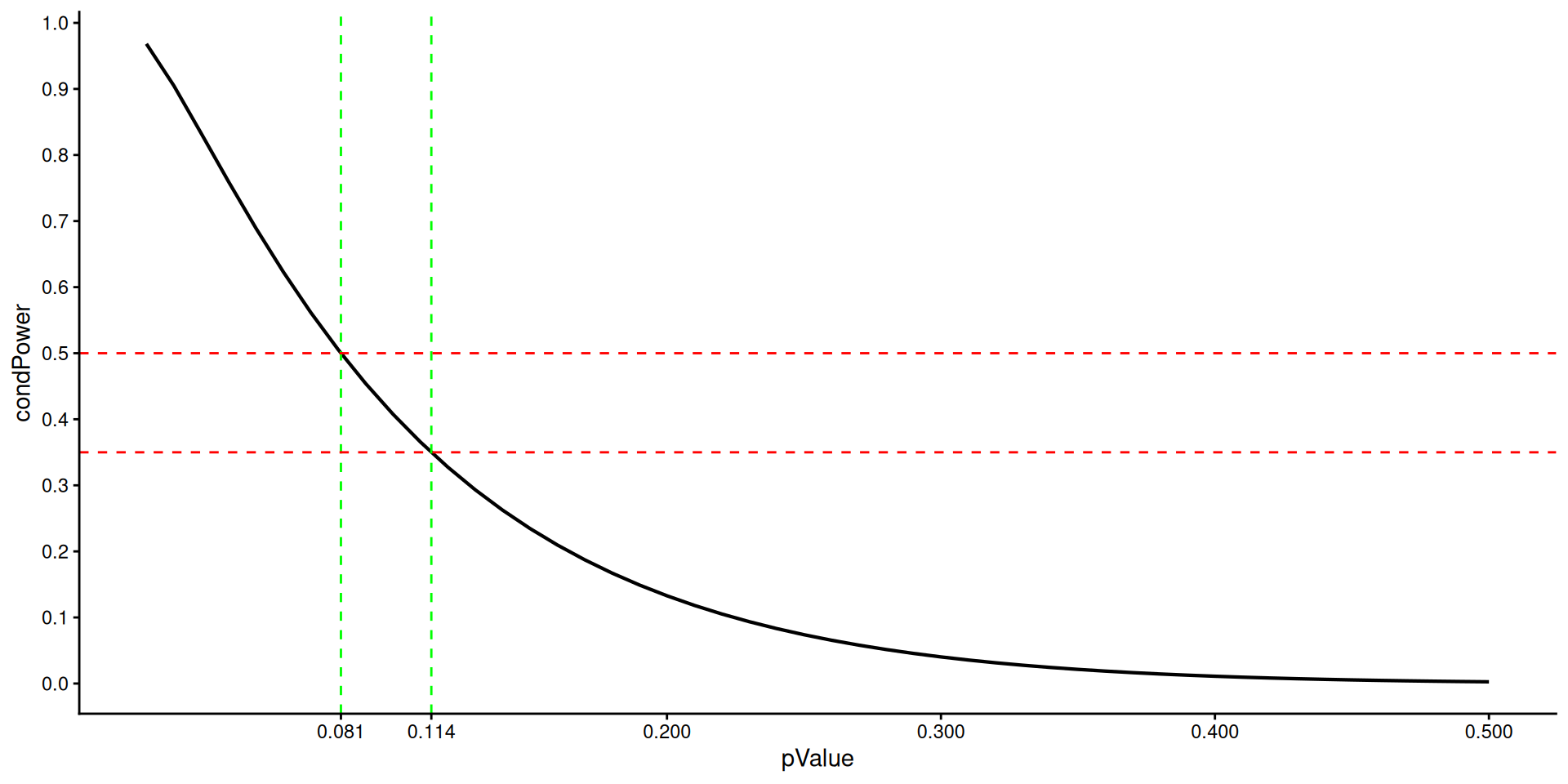
p-value vs. conditional power at observed effect
Promizing zone approach (Mehta and Pocock (2011)): Increase sample size if conditional power at observed effect exceeds 50% (refined values exist). Then traditional test statistic can be used.
design <- getDesignGroupSequential(
    kMax = 2,
    typeOfDesign = "OF",
    alpha = 0.025
)

futilityBounds <- seq(0.01, 0.5, by = 0.01)

y <- design |>
    getFutilityBounds(
        sourceValue = futilityBounds,
        sourceScale = "pValue",
        targetScale = "condPowerAtObserved"
    )

dat <- data.frame(
    pValue = futilityBounds,
    condPower = y
)

ggplot(dat, aes(pValue, condPower)) +
    geom_line(lwd = 0.75) +
    geom_vline(
        xintercept = c(0.081, 0.114),
        linetype = "dashed",
        color = "green",
        lwd = 0.5
    ) +
    geom_hline(
        yintercept = c(0.35, 0.5),
        linetype = "dashed",
        color = "red",
        lwd = 0.5
    ) +
    scale_x_continuous(breaks = c(0.081, 0.114, 0.2, 0.3, 0.4, 0.5)) +
    scale_y_continuous(breaks = seq(0, 1, 0.1)) +
    theme_classic()
p-value vs. conditional power at observed effect
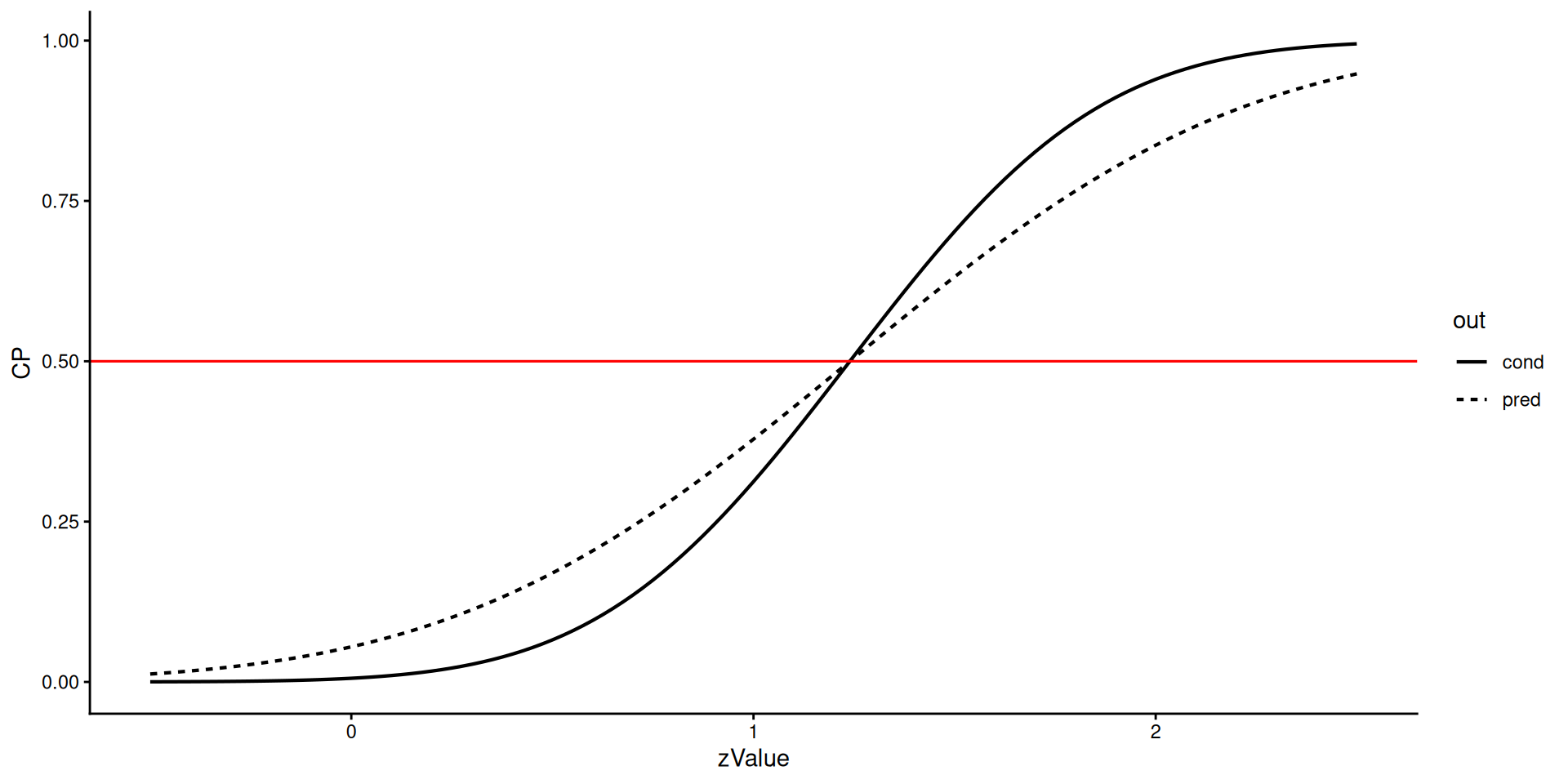
Bayesian predictive power vs. conditional power at observed effect
design <- getDesignGroupSequential(
    typeOfDesign = "noEarlyEfficacy",
    alpha = 0.025,
    informationRates = c(0.4, 1)
)

futilityBounds <- seq(-0.5, 2.5, by = 0.025)

y <- design |>
    getFutilityBounds(
        sourceValue = futilityBounds,
        sourceScale = "zValue",
        targetScale = "predictivePower"
    )
dat <- data.frame(
    zValue = futilityBounds,
    CP = y,
    out = "pred"
)

y <- design |>
    getFutilityBounds(
        sourceValue = futilityBounds,
        sourceScale = "zValue",
        targetScale = "condPowerAtObserved"
    )
dat <- dat |> rbind(
    data.frame(
        zValue = futilityBounds,
        CP = y,
        out = "cond"
    )
)

ggplot(dat, aes(zValue, CP, out)) +
    geom_line(aes(linetype = out), lwd = 0.75) +
    geom_hline(yintercept = 0.5, color = "red", lwd = 0.55) +
    theme_classic()
Bayesian predictive power vs. conditional power at observed effect
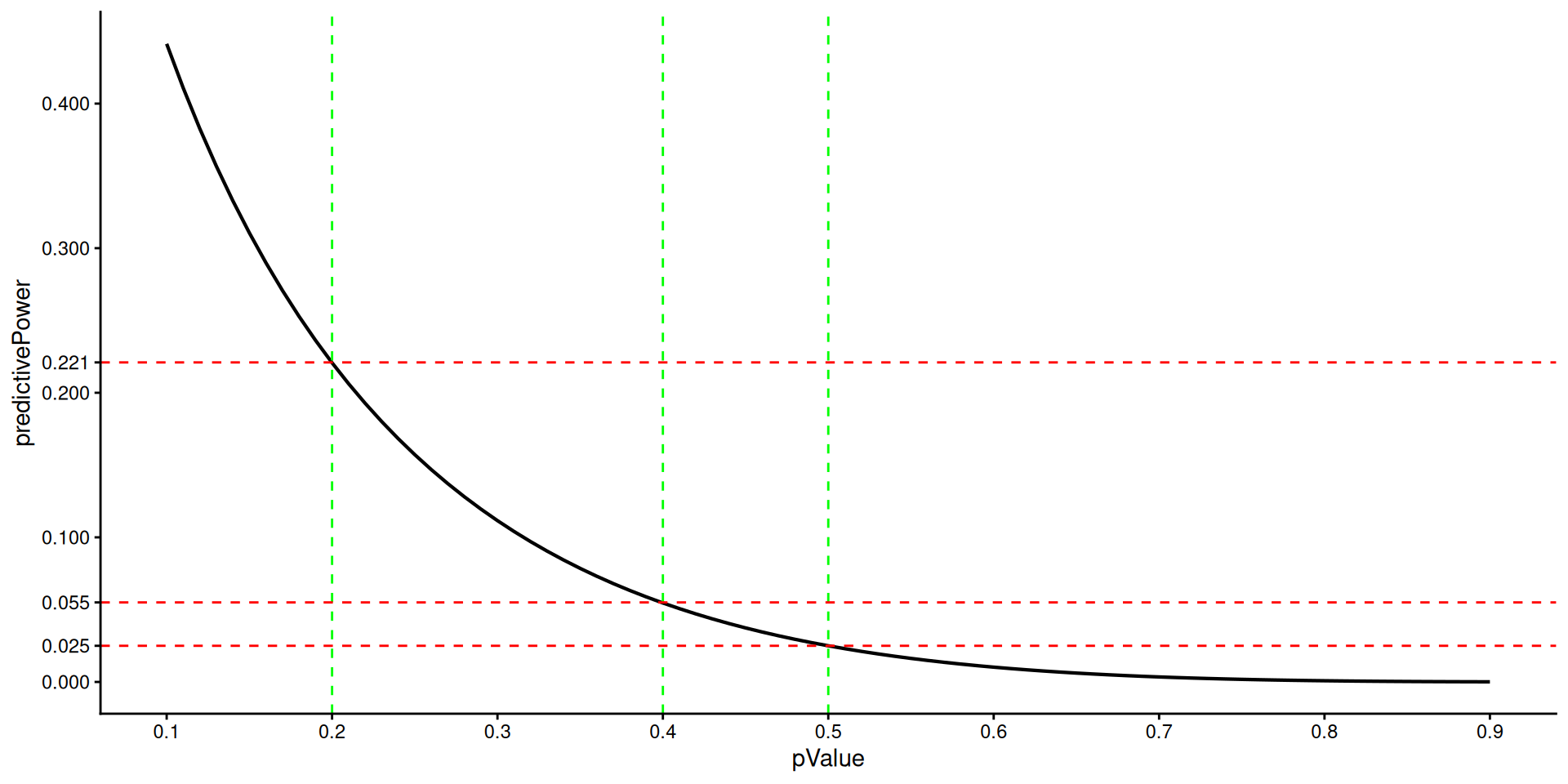
p-value vs. Bayesian predictive power/reverse conditional power
design <- getDesignGroupSequential(
    kMax = 2,
    typeOfDesign = "noEarlyEfficacy",
    alpha = 0.025
)

futilityBounds <- seq(0.1, 0.9, by = 0.01)
y <- design |>
    getFutilityBounds(
        sourceValue = futilityBounds,
        sourceScale = "pValue",
        targetScale = "predictivePower"
    )
dat <- data.frame(
    pValue = futilityBounds,
    predictivePower = y
)

ggplot(dat, aes(pValue, predictivePower)) +
    geom_line(lwd = 0.75) +
    geom_vline(
        xintercept = c(0.2, 0.4, 0.5),
        linetype = "dashed",
        color = "green",
        lwd = 0.5
    ) +
    geom_hline(
        yintercept = c(0.025, 0.055, 0.221),
        linetype = "dashed",
        color = "red",
        lwd = 0.5
    ) +
    scale_x_continuous(breaks = seq(0, 1, 0.1)) +
    scale_y_continuous(breaks = c(0, 0.025, 0.055, 0.1, 0.2, 0.221, 0.3, 0.4)) +
    theme_classic()
p-value vs. Bayesian predictive power/reverse conditional power
Summary
- Several possibilities to define futility stopping
- Predictive interval plots might be another alternative (cf., Ortega-Villa et al. (2025))
- beta spending function might help to construct futility bounds
- All boundaries should be considered as guidelines rather than strict rules, i.e., as a non-binding rule.
getFutilityBounds()function as a separate tool- Requires
rpact 4.3.0 - Extensively tested, e.g., through reverse checks
- Will be included in sample size and power calculation features, esp., to obtain informations and effect size automatically.
2. Delayed Response
- The delayed response group sequential methodology from Hampson and Jennison (2013) defines a proper consideration of the “pipeline” patients who have been treated at interim but are yet to respond
getDesignGroupSequential(),getDesignCharacteristics(), and the correspondinggetSampleSizexxx()andgetPowerxxx()functions characterize a delayed response group sequential test given certain input parameters in terms of power, maximum sample size and expected sample size- Other approaches can conveniently be handled with the newly published function
getGroupSequentialProbabilities() - Details and examples provided in Vignette Delayed Response Design with rpact.
- Joint work with Stephen Schüürhuis (Schüürhuis, Konietschke, and Kunz (2024) ; Schüürhuis et al. (2024))
Methodology of Delayed Response Designs
Given boundary sets \(\{u^0_1,\dots,u^0_{K-1}\}\), \(\{u_1,\dots,u_K\}\) and \(\{c_1,\dots,c_K\}\), a \(K\)-stage delayed response group sequential design has the following structure:
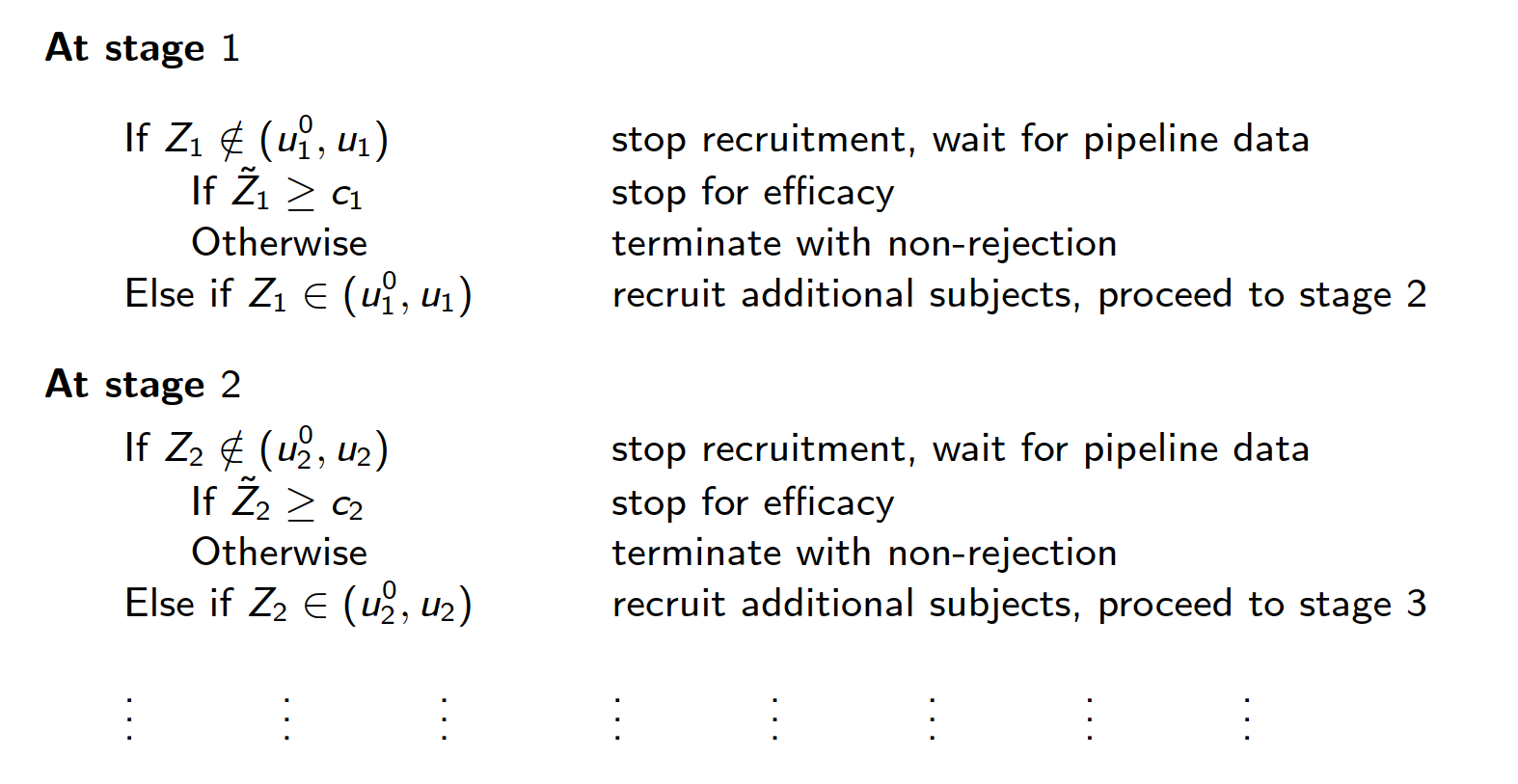
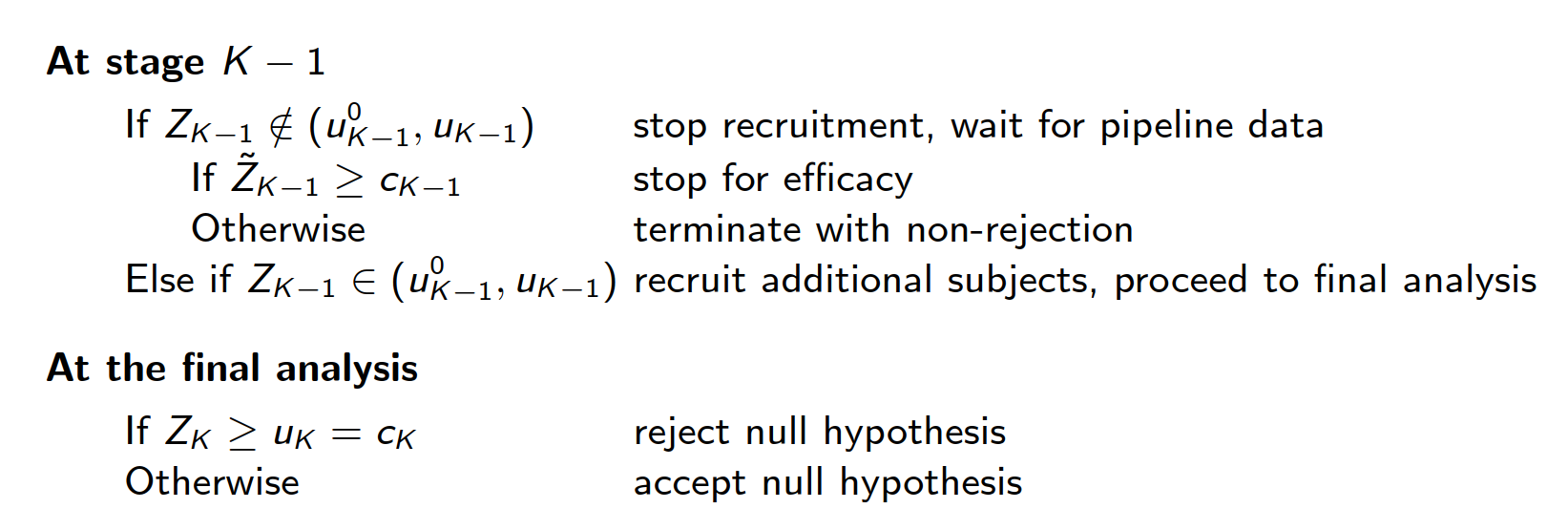
According to Hampson and Jennison (2013), the boundaries \(\{c_1, \dots, c_K\}\) with \(c_K = u_K\) are chosen such that “reversal probabilities” are balanced, to ensure type I error control.
More precisely, \(c_1,\ldots,c_{K - 1}\) are chosen as the (unique) solution of: \[\begin{align*} \begin{split} &P_{H_0}(Z_1 \in (u^0_1, u_1), \dots, Z_{k-1} \in (u^0_{k-1}, u_{k-1}), Z_k \geq u_k, \tilde{Z}_k \leq c_k) \\ &= P_{H_0}(Z_1 \in (u^0_1, u_1), \dots, Z_{k-1} \in (u^0_{k-1}, u_{k-1}), Z_k \leq u^0_k, \tilde{Z}_k \geq c_k). \end{split} \end{align*}\]
Delayed Response: Example
Delayed Response: Example
Sequential analysis with a maximum of 3 looks (delayed response group sequential design)
Kim & DeMets alpha spending design with delayed response (gammaA = 2) and Kim & DeMets beta spending (gammaB = 2), one-sided overall significance level 2.5%, power 80%, undefined endpoint, inflation factor 1.0514, ASN H1 0.9269, ASN H01 0.9329, ASN H0 0.8165.
| Stage | 1 | 2 | 3 |
|---|---|---|---|
| Planned information rate | 30% | 70% | 100% |
| Delayed information | 16% | 20% | |
| Cumulative alpha spent | 0.0022 | 0.0122 | 0.0250 |
| Cumulative beta spent | 0.0180 | 0.0980 | 0.2000 |
| Stage levels (one-sided) | 0.0022 | 0.0109 | 0.0212 |
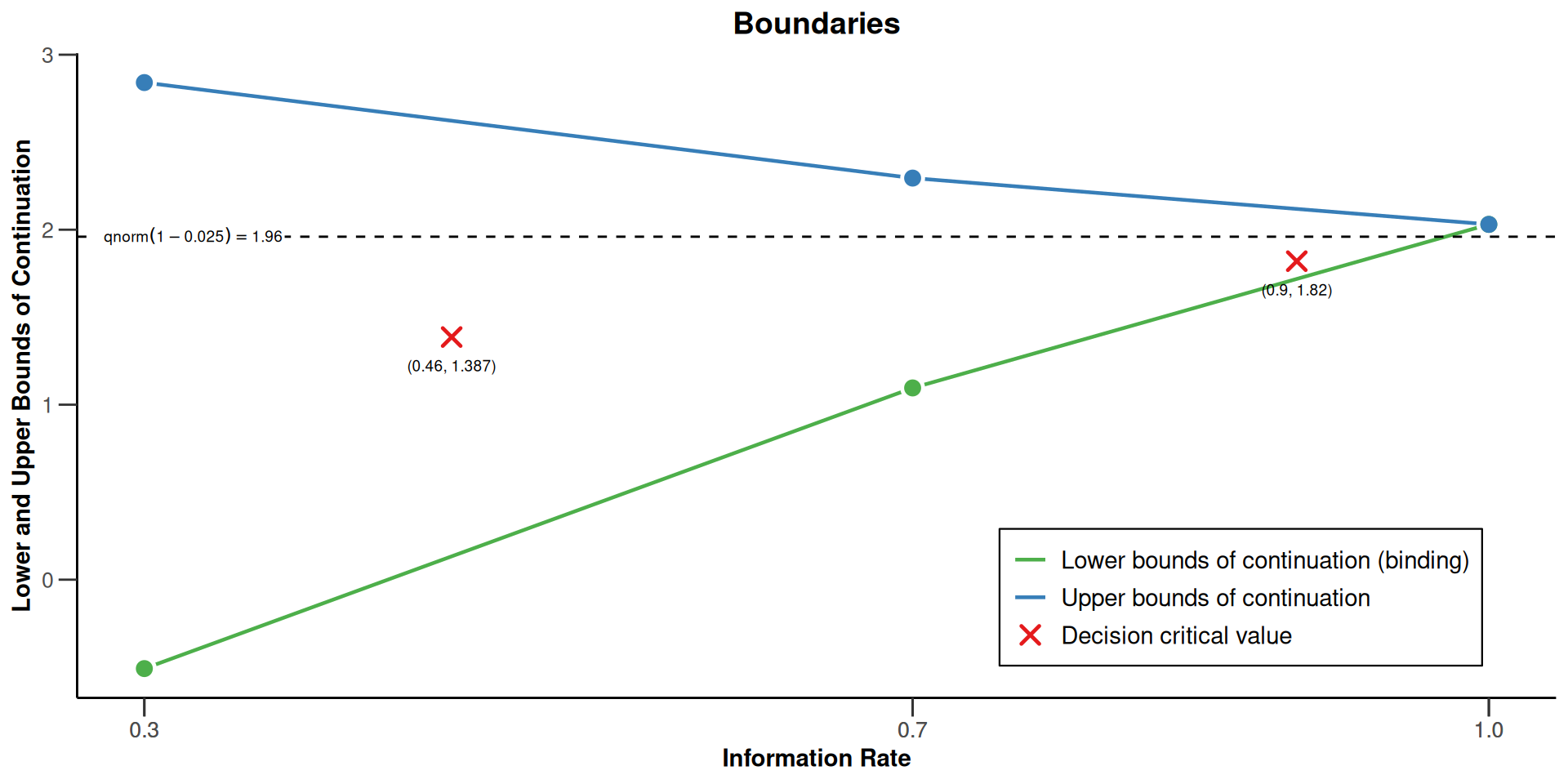
| Upper bounds of continuation | 2.841 | 2.295 | 2.030 |
| Lower bounds of continuation (binding) | -0.508 | 1.096 | |
| Decision critical values | 1.387 | 1.820 | 2.030 |
| Reversal probabilities | <0.0001 | 0.0018 | |
| Cumulative power | 0.1026 | 0.5563 | 0.8000 |
| Futility probabilities under H1 | 0.019 | 0.083 |
Delayed Response: Plot
3. Count Data
getSampleSizeCounts()andgetPowerCounts()- Perform sample size calculations and the assessment of test characteristics for clinical trials with negative binomial distributed count data.
- Fixed sample size and group sequential designs (Mütze et al. (2019))
- Perform blinded sample size reassessments according to Friede and Schmidli (2010)
- Output boundary values also on the treatment effect scale
- New function
getSimulationCounts()- Perform power simulations for clinical trials with negative binomial distributed count data
- Simulated power, stopping probabilities, conditional power, and expected sample size for testing mean rates for negative binomial distributed event numbers in the two treatment groups testing situation
Count Data: Options
- Either both event rates \(\lambda_1\) and \(\lambda_2\), or \(\lambda_2\) and rate ratio \(\theta\), or \(\lambda\) and \(\theta\) (blinded sample size reassessment!)
- \(\lambda_1\) and \(\theta\) can be vectors
- Different ways of calculation:
- fixed exposure time,
- accrual and study time,
- or accrual and fixed number of patients
- Staggered patient entry
- Group sequential or fixed sample size setting
- Details and examples provided in Vignette Count Data with rpact
Count Data: Simple Example
Count Data: Simple Example
Sample size calculation for a count data endpoint
Fixed sample analysis, two-sided significance level 5%, power 90%. The results were calculated for a two-sample Wald-test for count data, H0: lambda(1) / lambda(2) = 1, H1: effect = 0.75, lambda(2) = 0.4, overdispersion = 0.5, fixed exposure time = 1.
| Stage | Fixed |
|---|---|
| Stage level (two-sided) | 0.0500 |
| Efficacy boundary (z-value scale) | 1.960 |
| Lower efficacy boundary (t) | 0.844 |
| Upper efficacy boundary (t) | 1.171 |
| Lambda(1) | 0.300 |
| Number of subjects | 1736.0 |
| Maximum information | 127.0 |
Legend:
- (t): treatment effect scale
Count Data: Power Calculation
Count Data: Power Simulation
$overallReject
[1] 0.835 0.0281.319 sec elapsedRPACT Cloud
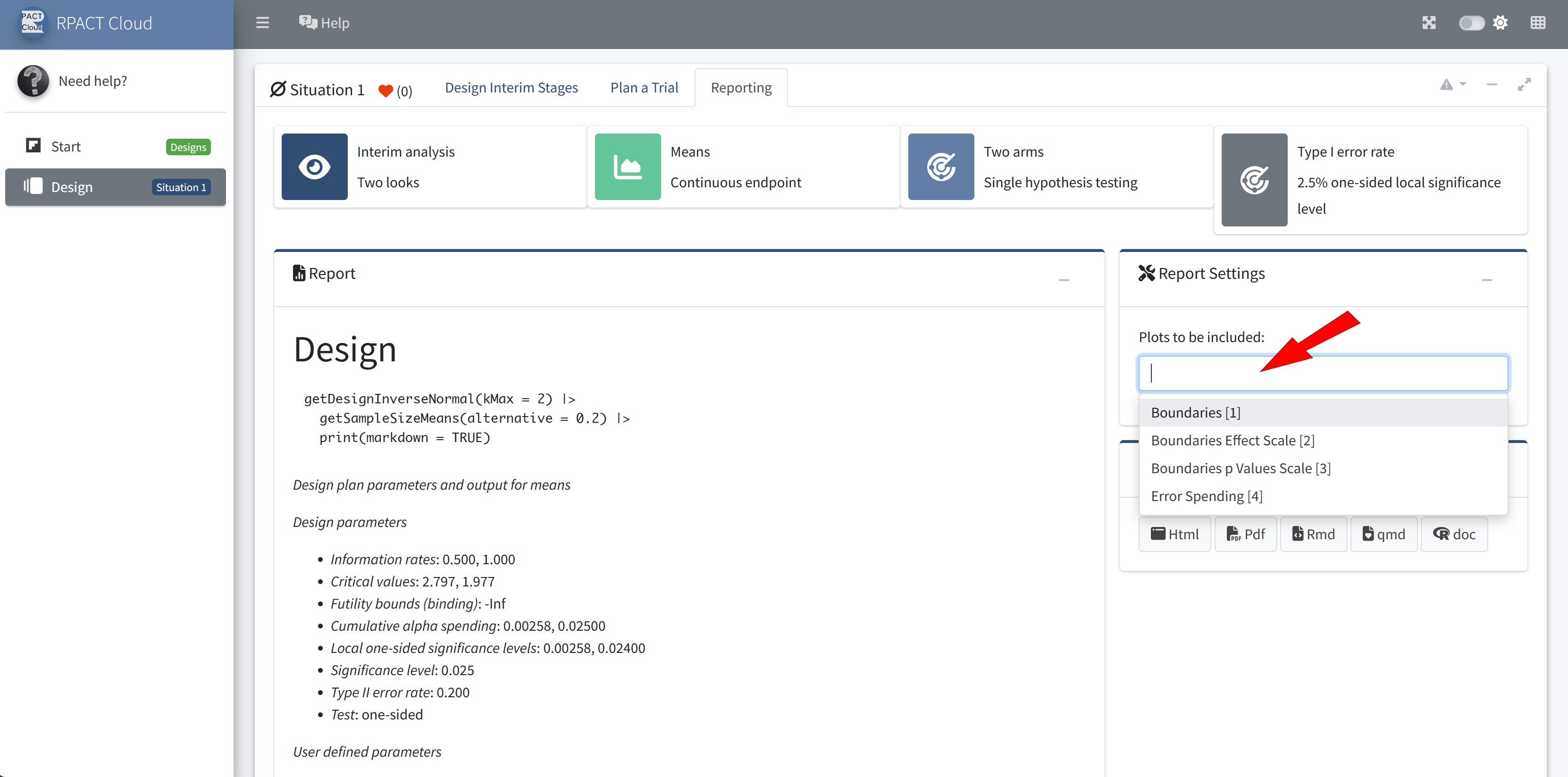
RPACT Cloud ☁️
Graphical user interface
Web based usage without local installation on nearly any device
Provides an easy entry to to learn and demonstrate the usage of
rpactStarting point for your R Markdown or Quarto reports
Online available at rpact.cloud
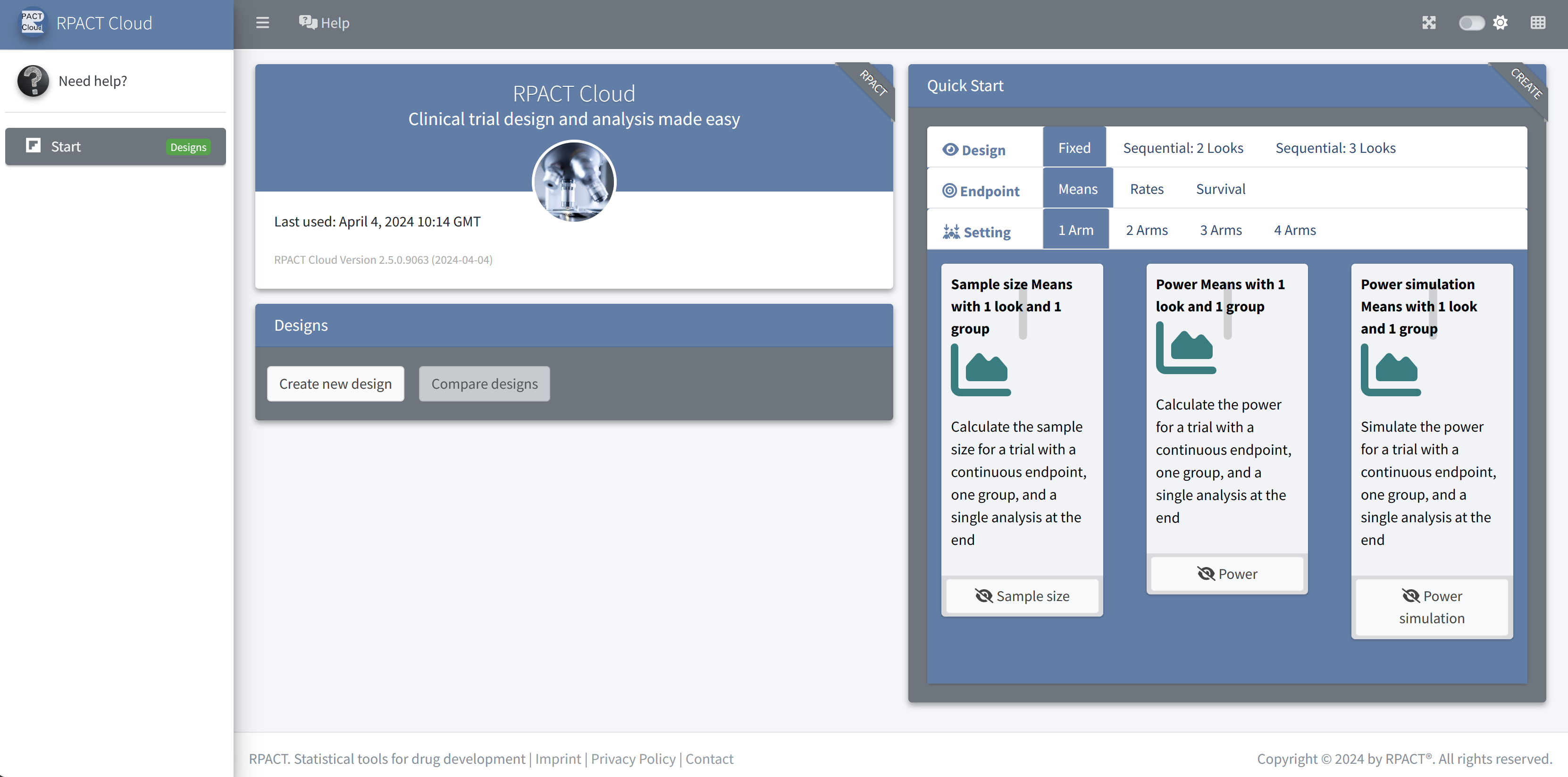
Start Page
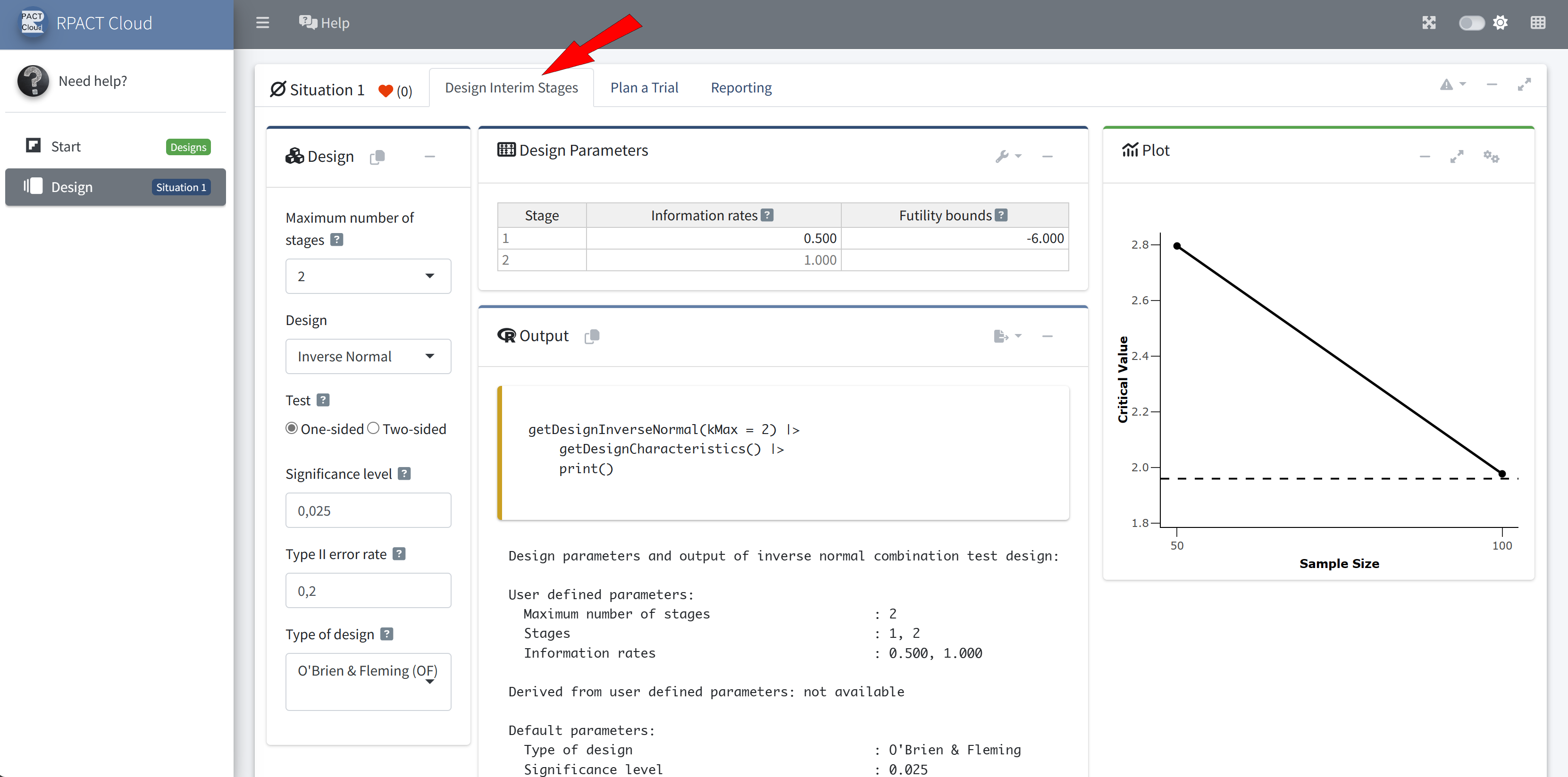
Design
Reporting
What’s Next?

New Package Features
Just in the near future you will see in rpact:
- Patient level survival data simulations for multi-arm and enrichment designs
- Optimum conditional error functions according to Brannath et al. (2024) (package optconerrf published on CRAN Sep 09, 2025)
- Least square means interface for continuous endpoints
The R Package rpact - Online Resources
Further information, installation, and usage:
- CRAN: cran.r-project.org/package=rpact
- GitHub: github.com/rpact-com/rpact
- GitHub Pages: rpact-com.github.io/rpact
- OpenSci R-universe: rpact-com.r-universe.dev/rpact
- METACRAN: r-pkg.org/pkg/rpact
- Codecov: app.codecov.io/gh/rpact-com/rpact
- RPACT manual and vignettes: rpact.org
- RPACT validation and training: rpact.com
All information and resources about RPACT on one dashboard page
RPACT Connect: connect.rpact.com
RPACT Connect